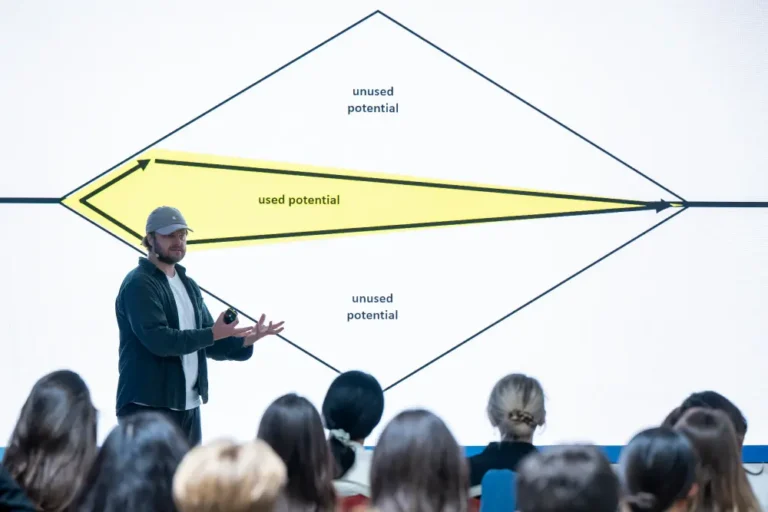
The topic has reached the center of the leadership debate
Harvard Business Manager interviewed Tobias Eismann and Martin Meinel from the Creativity Lab for a feature article on one of the most pressing leadership questions right now: Why do teams fail to develop truly new ideas, and what does that have to do with their leadership?
That HBM is asking exactly here is no coincidence. It is a signal that the topic of creativity as a leadership responsibility has arrived in business practice. And that the Creativity Lab is the address when it comes to scientifically grounded answers and creativity training for managers.
Read the full article here
Our work goes deeper than the interview, of course. We explain what lies behind the problem and what leaders can concretely do, based on psychology, neuroscience, and what we observe daily in our programs.
The Problem Is Not the People
When teams are not creative, it is rarely due to a lack of talent. It is almost always due to leadership behavior that structurally makes creative thinking impossible, often without anyone intending it.
The core problem: Divergent Thinking and Convergent Thinking are two modes of thinking that are mutually exclusive. Generating ideas and evaluating ideas cannot happen simultaneously. Leaders who demand ideas in a meeting and in the same breath comment on them, prioritize them, or greet them with a skeptical look shut down the open mode in the room.
This is the result of years of training in convergence. Decide, prioritize, deliver. That is the logic in which successful leaders grew up. In creative processes, that exact logic acts as a brake.
We see this in every workshop. We see it in every project. It is consistent, predictable, and entirely changeable.
Status Quo Bias: The Invisible Brake
Something even deeper lies behind this behavior. The brain optimizes for efficiency. Familiar patterns cost less cognitive energy. New ideas initially seem risky, unfinished, hard to categorize. In organizations oriented toward control and predictability, this bias is amplified further by hierarchy and time pressure.
The result: leaders who live in reactive mode lose the capacity for deliberate observing. Those who do not observe do not ask uncomfortable questions. Rethinking withers into a rarity. Teams quickly learn what is actually desired here: no surprises, no friction, no ideas that put the plan at risk.
We call this Status Quo Bias. It is, based on everything we know from research and practice, the single largest barrier to innovation in organizations.

What Leaders Can Concretely Do
Leadership for creativity is not a philosophy. It is behavior. Observable, trainable, and measurable. We have identified 18 such behaviors. Here are the five that carry the greatest leverage in a leadership context.
1. Open the space before closing it
Psychological safety is created through behavior. Who speaks first in a meeting? Who evaluates before everyone has been heard? Active Listening is the most underestimated leadership behavior of all. Teams that feel heard take risks. Teams that feel controlled avoid them.
2. Actively seek out different perspectives
Homogeneous teams think homogeneously. That is not a criticism, it is a well-documented finding from creativity research. Diversifying is a direct leadership decision with an immediate impact on the quality of ideas.
3. Share openly what occupies you
Leaders who make their own questions, doubts, and problems visible give their teams permission to do the same. Cultivating starts at the top. Those who want to model openness must show it themselves first.
4. Tolerate ambiguity
Creative processes are by definition uncertain. Leaders who switch to control mode during open phases kill exactly the space in which something new can emerge. Sensemaking provides orientation without closing off openness. That is a fundamental difference from classical leadership logic.
5. Make creativity a habit
One-off workshops fade away. What remains are behaviors anchored in everyday life. Ritualizing means transferring creative behavior into repeatable routines. Small anchors, fixed moments, clear triggers. That is the difference between a creativity culture and a creativity event.
Knowledge Changes Nothing. Behavior Does.
Many leaders know that they might be blocking creativity. Knowledge alone changes nothing. Behavioral change requires structure, feedback, and time.
The Creativity Lab has identified 18 core behaviors, based on psychology and neuroscience, that explain and make creative performance trainable. Five clusters: Perceiving, Rethinking, Cultivating, Ideating, Sensemaking. Build from research and from practice with real teams in one of the most complex technology companies in the world.
Leading is one of these behaviors. It describes the ability to take responsibility for the creative process of a group and to actively steer when a team should think more broadly and when it is time to focus. A concrete, observable, trainable behavior.
That is the difference between what we do and what most others offer. Scientifically grounded behavioral change training, tailored to the everyday reality of engineers, IT professionals, and managers in a technology-driven corporate environment.
Read what Tobias Eismann and Martin Meinel told Harvard Business Manager, and then come right back to book your spot.
Learn Leadership for Creativity
The Creativity Lab’s Leading for Creativity program is built for leaders who have understood that creativity is not a matter of chance, and who are ready to change their own behavior for it.
Scientific foundations. Concrete behavioral interventions. Direct transfer into everyday leadership. For teams that need to deliver.