Innovation Journey

Duration

14 Months

Number of Participants

20

Type

DISCOVERY flex

Impact

How we empowered a Siemens engineering team to challenge industry convention and achieve a breakthrough in switchgear design.

The Overview

One Idea. One Team. One New Architecture.
When new industry requirements made the insulating medium used in an entire category of medium-voltage switchgear obsolete, a Siemens engineering team faced a real design challenge: rethink a product built the same way for decades, under tighter constraints, with no established blueprint. The Creativity Lab partnered with this team for nearly a year, embedding creative methods directly into their daily engineering work. One leader, one unconventional idea, and a room full of quiet skeptics became a cross-cultural team that produced a result that surprised even themselves.

The Story

How we met.

Before this project existed, there was one engineer with a question he could not let go of: what if this component did not have to be designed the way it always had been? Kay, a team leader in Siemens’ R&D environment, had already completed the Creativity Lab’s “Leading for Creativity” program before bringing this challenge forward. He arrived with a specific engineering problem, a regulatory deadline, a cost constraint, and an idea that contradicted every convention in his field.

The Problem

New Industry Requirements. The Old Answer Was No Longer Good Enough.
New industry requirements were phasing out the insulating medium that had made an entire generation of medium-voltage switchgear work. Removing it changed the physical demands on the component entirely. Simply reinforcing the existing design was technically possible but commercially unacceptable. The team needed a solution that met new engineering requirements without inflating cost or complexity. That meant questioning a design logic that had gone unquestioned across the entire industry for years. The real obstacle was creating enough room to think differently about a problem everyone assumed was already well understood.

Creativity Lab – Breakthrough Consulting

Take a look at our breakthrough consulting and discover the individual journey to our clients’ transformation.

Project

Initiation

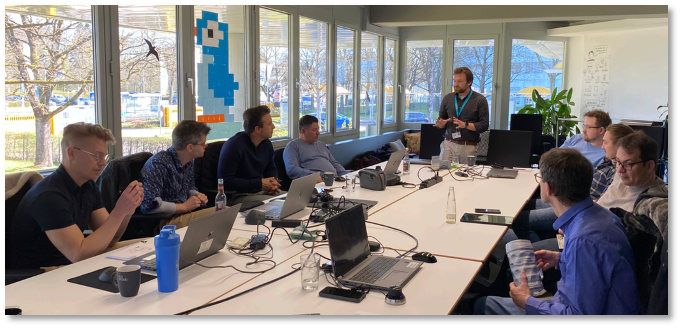
Kay had a vision for a fundamentally new component design but no working team and no proof the idea would hold. The Creativity Lab structured the collaboration as a Discovery X engagement: nearly a year of daily creative sessions combined with periodic on-site workshops. The first task was building a team. Martin and Stefan ran the initial kickoff workshop with Kay and three colleagues, designing exercises that required the group to make things together, to interact in ways a standard engineering meeting never creates.

Problem Space

Exploration

The team members were highly capable engineers, each deeply expert in machine building and electrical engineering. Going in, everyone assumed that shared expertise meant a shared way of thinking. The Creativity Lab’s methods revealed something different: underneath the common professional background were genuinely distinct personalities, problem-solving styles, and creative preferences that had never been made visible before. Making those differences explicit changed how the team listened to each other and how ideas moved through the group.

Solution

Creation

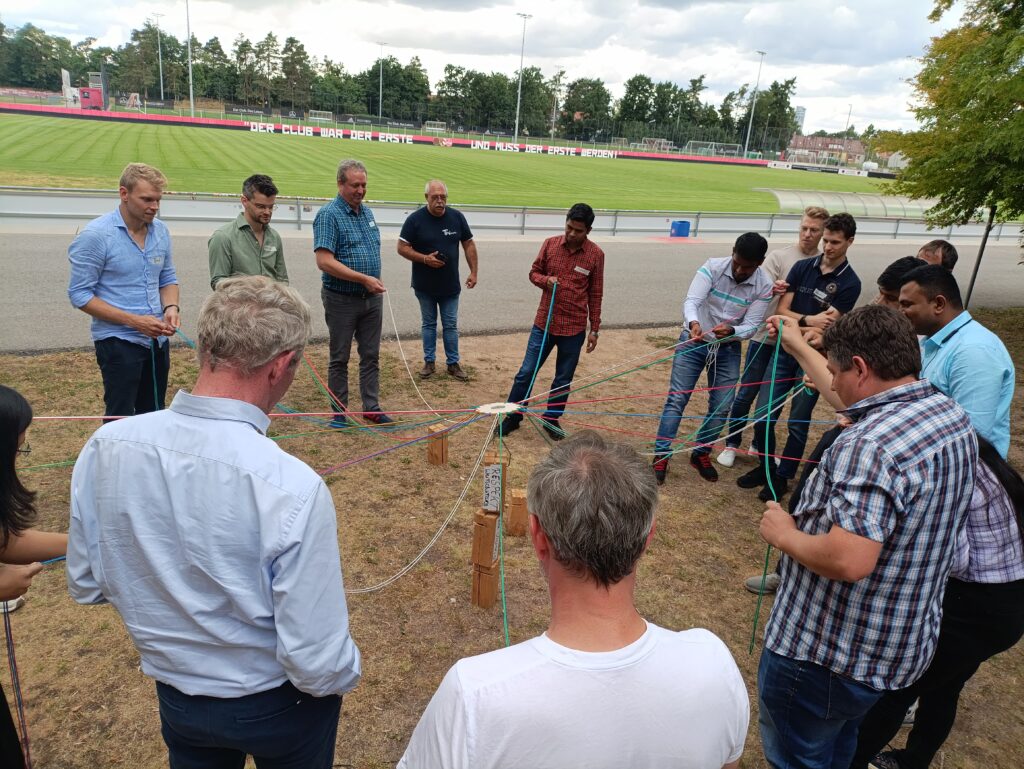
Daily sessions became the engine of the project, each week organized around a specific challenge: a component, a constraint, a sub-problem. This “Challenge of the Week” structure gave the team rhythm and forward movement. Methods included morphological analysis, analogy-based scenario thinking, and digital collaboration boards requiring a minimum of three ideas per prompt. Siemens additive manufacturing experts based in Munich were brought in for fresh perspective. When Indian colleagues joined the project, the Creativity Lab organized a three-day on-site workshop in Nuremberg and online intercultural sessions to help the international team understand how each other thought and worked.

Breakthrough

Execution

For a long time, the new architecture existed only on paper and in digital models. In engineering, that is where ideas live until reality decides whether they work. The team moved through a deliberate prototyping sequence, starting with 3D-printed models to test basic geometry and fit, then progressing to rough physical prototypes in metal to test structural behavior under real conditions. Each step raised the resolution of the question: does this actually hold? When the final prototype went into a standard burst pressure test, the result exceeded every expectation the team had brought into the room. The reaction from engineers who had spent months skeptical of the new direction: “No way!”

Outcome

A team that started as one person with an idea and three quiet colleagues became roughly twenty engineers across two countries who collaborate openly, surface assumptions early, and apply creative methods without being prompted. The new architecture of switchgear design performed beyond what the team had considered realistic, with the true upper limit still unknown.
The Creativity Lab’s goal for the final phase was to make itself unnecessary: to ensure the team could sustain this way of working on their own. That is the real measure of whether the work was genuine. If your team is facing a problem where conventional answers fall short and the real obstacle is the thinking patterns that keep certain solutions invisible, the Discovery X approach is what a different kind of result looks like.

Let’s Start!

You thought becoming more creative was that easy? Too good to be true!

Investing in creativity to solve your challenges takes time. We work with science-based approaches to create environments that foster the creativity of you, your team, and the entire organization. What’s your creative challenge?